

The Knights Templar and the Head of God
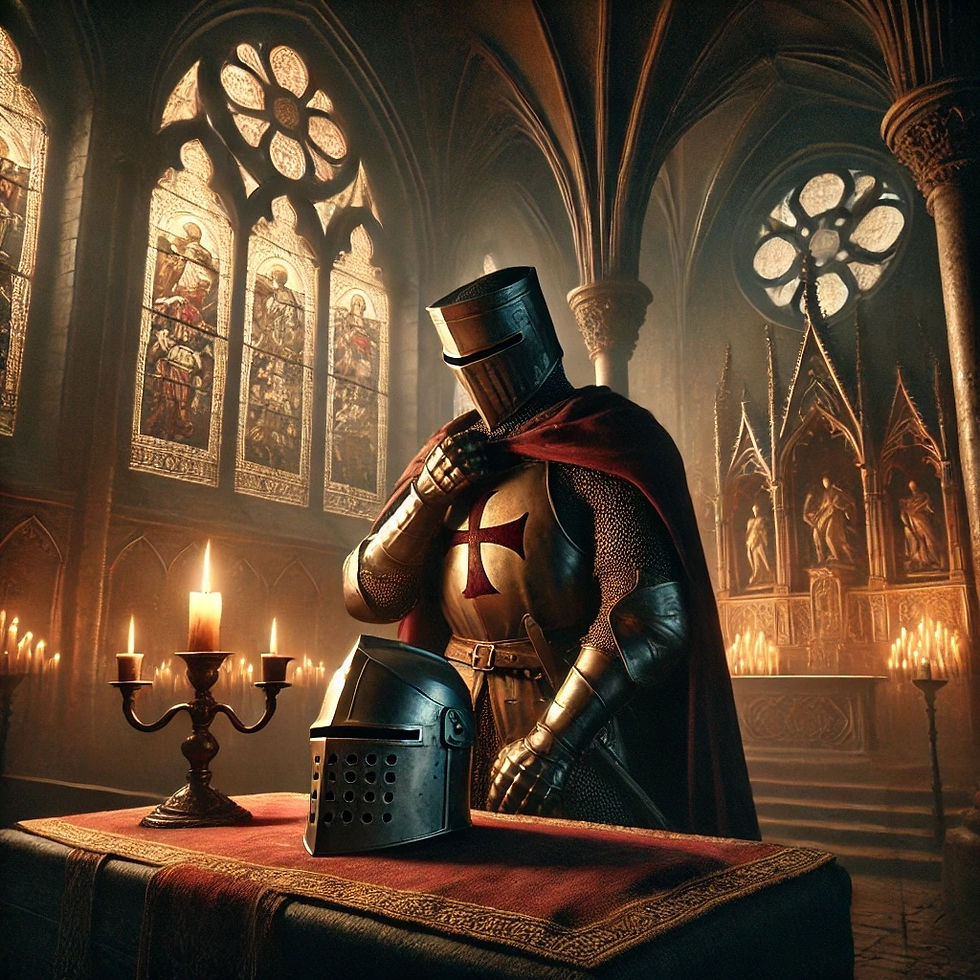
Temple Church
(Excerpt from Stone of the Saviour: The Return of the She Christ)
I felt compelled to explore what the Knights Templar had left behind,
to study firsthand their works and legacy, and to delve deeper into their
legends. My journey led me to Temple Church in London, a site of great
importance to the Templars, and a location that highlights their role
within medieval Europe. From there, I travelled to Rennes-la-Château,
a village shrouded in mystery, where sacred geometry, hidden symbols,
and the legends of the Templars intertwined in ways I had not expected.
We looked briefly at the work of David Wood earlier, and his book,
Genisis. But as well as being an author, Wood was also a trigonometrical
and topographical surveyor known for mapping out the area of Rennesle-
Château, France, and providing evidence of a pentagram set into the
landscape encompassing and surrounding this village.
Rennes-le-Château was the main destination for my European visit in
the Spring of 2008. Henry Lincoln, who had a deep respect for Wood’s
work, and who wrote the foreword to his book, Genisis, continued his
own explorations in this field, which he recorded in his book, Key to
the Sacred Pattern: The Untold Story of Rennes-le-Château. This small
village of just under 100 people is wrapped in legend, drawing seekers
like me with its stories of the Knights Templar, sacred geometry, and
hidden symbols, both within and outside the Catholic Church which
sits at the heart of both the village and the myths.
Inspired by the works of Wood, Lincoln, and others, I travelled
to this intriguing place, unaware of how deeply it would shape my
understanding of the sacred feminine and the power of the pentagram
set into the landscape.
I arrived in the village of Rennes-le-Château around midday in the
Spring of 2008. After a quick coffee at the local café, I made my way
to the village church, which had once been the private chapel of its
former noblewoman Marie d’Hautpoul. I was immediately greeted at
the door by a Devil carved from plaster, a Devil called Asmodeus by
author Gérard de Sède in his book, The Accursed Treasure of Rennesle-
Château, published in 1967. Asmodeus is considered “the worst of
demons” according to the Testament of Solomon, a text attributed to
King Solomon himself, a man who is said to have been the son of a
human mother, and a father who was an angel. I decided to approach
the statue of Asmodeus, known as the King of the World to the Cathars,
and touch his hand, both to pay my respects and acknowledge his
early morning warning not to tell the story of the woman crucified
in my dream. I did not know back then, in 2008, that this village sat
within a sacred pentagram as discovered by Wood and Lincoln, but I
did know I was no match for this powerful entity thousands of miles
away from my home.
The cold plaster hand I touched sat perched on his knee, the exact
same knee of the same leg that had been broken off from the plaster statue
of the woman crucified in my dream. Looking at his bulging eyes
that stared at the black and white tiled floor beneath our feet, I told the
Devil that I could not keep his secret. I then lifted my hand from his
and walked into the ancient Catholic Church of Rennes-le-Château. I
might not have been so bold if I had known that I was standing in a pentagram
that Asmodeus, the worst of demons, quite possibly controlled.
Two days before I arrived in this village, I had visited Temple Church
in London, a circular church built by the Knights Templar to serve as
their English headquarters, and the place where initiations into their
order were carried out. The church was consecrated by the Roman Catholic
Church in 1185 and almost destroyed by the Germans in the Blitz,
an extensive bombing campaign that targeted London during WWII.
The church consists of two sections: the round nave, known as the
Round Church, which was designed and built to replicate the Church of
the Holy Sepulchre in Jerusalem, and a large rectangular section called
a chancel, meaning “the space around the altar”. The church served as
a royal treasury under King John, with the Knights Templar acting as
proto-international bankers. After King Philip IV of France had the
Templars arrested and charged with heresy, which led ultimately to
their demise, ownership of Temple Church passed to another Catholic
military order known as the Knights Hospitaller. The Knights Hospitaller
would eventually lease the church to the Inner and Middle Temple,
two of the four British legal professional associations.
It was lightly raining on the morning I arrived at Temple Church, and
in the rush to add it to my agenda before leaving London for France the
next day, I had forgotten to check the opening hours. As it transpired,
I was forty minutes early, and the doors were locked. Walking around
the church courtyard in the fine wet mist of London, I observed that
the walkways, now glossy with rain and marked by gravestones, set a
sombre scene. I pondered the history of the Knights Templar, particularly
the Inquisition waged against them by King Philip IV and the
eventual burning at the stake of their leader, Jacques de Molay, which
ended the order not just in France but across Europe.
There were several ways to enter Temple Church, and I chose to sit
outside the massive black door of the original Round Church. I settled
in for the remainder of my wait, pulling out a journal from my purse to
capture my thoughts. Suddenly, I felt a need to pray, to lay down some
tobacco and ask permission to be at this church before I entered this
sacred space. I felt that this door, with its old steel handle, and its massive
keyhole that was large enough to pass a cell phone through, was
the door by which I should enter. I wrote in my journal, “I may not be
able to enter by this door, but things aren’t always as they should be.”
It turned out that I was the only one queuing up at this entrance as my
travelling companion had joined a group who were lined up in front
of another door across the courtyard. The size of that queue suggested
that the second door they were lined up outside, was the one that was
used most often. I watched that queue grow longer, my friend periodically
glancing at me, and I started to think that I was being silly and
decided it might be best if I joined her and the others. As I began to
turn away from the big black door to join them, I was instantly stopped
from doing so by an invisible force that attached itself to my crotch and
would not allow me to leave. Frozen in place, and with no idea what
would happen next, the black door began to open slowly, and a man
of small stature appeared from behind it. He looked at me briefly, then
calmly said, “Please come in.” At once, the invisible force let go of me,
the spell lifted, and I was allowed to walk through the door and into
Round Church.
I was finally inside. In front of me, nine marble effigies of the Knights
Templar were laid out on the floor, their heads resting atop stones—
round stones known as pillow stones, in a round church in the heart
of London.
As I left the nave to tour the rest of the church, I discovered a stainedglass
panel above the altar in the chancel, overflowing with religious
iconography. Jesus was pictured at the top, having ascended to heaven,
and at the bottom of this lovely window, standing on the Earth, were a
trinity of people—a knight, a veiled woman, and a monk. We are told
that the monk is St. Francis of Assisi, who founded the Franciscan Order
and was known for his devotion to Jesus’ mother, Mary. I concluded
that the veiled woman standing in the centre was clearly Mary, and the
knight to her left was a Knight Templar. As relayed earlier, the veiling
of Mary was often used to signify a veiling of the truth. I instantly felt
a deep connection between Mary and the Templars, and I was struck
by a powerful thought. What if Head 58m, the head discovered in the
possession of the Knights Templar at the time of their arrest, was actually
the head of Mary?
We know, because of the records we have from the Inquisition, that
the Knights Templar were likely to have had numerous sacred heads in
their possession, with several historical researchers implying that those
heads were female. As we saw, some have even claimed that the Templars
owned the skull of Isis, so, what if they also possessed the skull of Mary?
St. Francis, the monk in the window I stood in front of, taught that
Mary was an important intermediary between humanity and God, and
he saw her as a protector of the Franciscan Order, referring to her in
his writings as a “beloved mother” who cared for the souls entrusted
to her. One of his prayers, Salutation to the Blessed Virgin Mary captures
his devotion:
Hail, O Lady, holy Queen, Mary, holy Mother of God: you are the
Virgin made Church, and the one chosen by the most holy Father
in heaven whom He consecrated with His most holy beloved Son
and with the Holy Spirit the Paraclete, in whom there was and
is all fullness of grace and every good.
Mary is a “chosen one”, and as I have shared previously, early Christians
put great emphasis on her role in the Holy Trinity, particularly
her possible connection to the role of the Holy Spirit.
Another term for the Holy Spirit is Paraclete, which is used in Christian
theology, where the Holy Spirit takes on the role of comforter,
advocate, counsellor, or helper. The term originates from the Ancient
Greek word Paraklētos, which means “one who is called alongside” or
“one who advocates or intercedes”. This concept is primarily found in
the New Testament, particularly in the Gospel of John. This description
of the Comforter, or Paraclete, is very similar to how the Church
describes Mary, as we find, for example, in John 14:16-17, where Jesus
speaks to his disciples about the coming of the Paraclete as an advocate:
And I will ask the Father, and He will give you another advocate
(Paraclete) to help you and be with you forever—the Spirit of
truth.
Here the Paraclete, or advocate, is said to stay with the people “forever.”
This is the keyword for our story, and it coincides with the quote we
examined earlier, by the nun and mystic Elisabeth of Schönau, who,
in The Resurrection of the Blessed Virgin, described Mother Mary as an
eternal figure, present at the beginning and the end of all things.
The Holy Spirit plays a significant role in the Christian understanding
of God’s presence after Jesus’ ascension into heaven. In this context,
the Holy Spirit is viewed as the divine helper who provides comfort,
reveals truth, strengthens faith, and enables believers to live according
to God’s will. The Holy Spirit is seen as the ongoing presence of God
in the world, guiding and sanctifying the Church—and believers. This
is the very definition of who Mary was, and is, within the Church. In
Christian doctrine, the Holy Spirit, as Paraclete, is also the third entity
in the Trinity, whom we have identified as Mary in Chapter Seven, the
equal of God the Father and God the Son.
St. Francis also refers to Mary in his salutation as the “Virgin made
Church”, making her the spiritual mother and protector of the faithful.
Another spiritual leader or parental figure referred to as the protector
of the faithful is the Pope. While protector of the faithful may not be
his official title, it does encapsulate the Pope’s pastoral mission within
the Church.
The Templars’ Divine Mission
Back in Temple Church, I also discovered that the stone effigies of the
nine Knights Templar lying on the floor of the round nave had their
eyes wide open, as if looking for someone or something. Tim Wallace-
Murphy suggests in his book, The Knights of the Holy Grail: The Secret
History of the Knights Templar that the Templars were not merely warriors,
but spiritual guardians linked to the prophecy of Christ’s return
who were safeguarding secret knowledge that would be instrumental
when that much anticipated day arrived. Wallace-Murphy ties this idea
to their role in protecting the Holy Grail and “other sacred relics”, all
of which were part of a divine mission that transcended their military
activities . Although Wallace-Murphy is more inclined to believe that
the Holy Grail is actually a royal bloodline, an idea popularized in Holy
Blood, Holy Grail and later in the book and movie The Da Vinci Code,
his revelations regarding the Templars’ true divine mission highlight
the significance of the heads they once possessed. These insights also
explain why the Templars worshipped the heads so fervently.
The concept of a line of Grail Bearers, women from a sacred bloodline,
is intriguing, but ultimately incorrect. The women whose heads
the Templars seem to have worshipped did not need to be related to
this bloodline, or even to each other. Instead, they each carried the
essence of the Holy Spirit, incarnating in specific times and places
where they and their mission were most needed. Their primary purpose
was to restore women to their sacred role within the Church, as
well as granting protection and abundance—ensuring that the flowers
bloomed every Spring.
Alongside this practical role, there was also the relationship to
Christ within the Holy Trinity, especially within the context of Christ’s
promise to leave with his people someone who would be with them
forever. This could only be accomplished through reincarnation—when
a person’s soul is reborn into a new body or form, continuing its journey
through multiple lifetimes. It is my belief that the Holy Spirit repeatedly
incarnates in human form until the mission is accomplished. I
also believe that the Templars understood this, seeking out these holy
women, protecting them as best they could while they lived, and then
using their heads as talismans, or teraphim, for ceremonial purposes
after they died.
I do, however, agree with Wallace-Murphy when he says that Eschenbach’s
Grail poem Parzival reveals a heretical belief system that contradicts
the teachings of the Roman Catholic Church:
The two principal Grail romances carry coded clues to a heretical
belief system embedded within them that contradict the
dogma of the Church. The King of the Grail castle, the wounded
Fisher King, imperfectly serves his impoverished realm just as
the usurpers of the true teachings of Jesus, those who lead the
Christian Church, despoil the spiritual lives of the flock they
claim to serve. When someone pure enough to see the Grail
restores the Fisher King to full health, his wasted kingdom will
be restored. Likewise, when the true teachings of Jesus triumph
over greed, lies, and distortion, the dream of heaven on earth
will become a reality.
I wholeheartedly agree with Wallace-Murphy. Returning to the Round
Church of the Templars, in London, here was a veiled Mary in the window
of their church that revealed a piece of the truth, a holy soul’s identity
hidden under a veil of secrecy that the Knights Templar had died for.
There are, of course, other veiled goddesses throughout history, one
of whom is Isis. Helena Blavatsky, in The Secret Doctrine, describes Isis,
the Egyptian goddess of wisdom, as veiled, reflecting the hidden truth
to be discovered by those initiated into the esoteric understandings of
groups like the Knights Templar:
Isis is a symbol of nature. Nature unveils herself only to him who
has learned to see beyond the veil.
The secret behind her veil is the knowledge that she was a part of
this divine line of women and, as David Wood suggests, the Knights
Templar may have been in possession of the skull of the Goddess Isis.

Comments